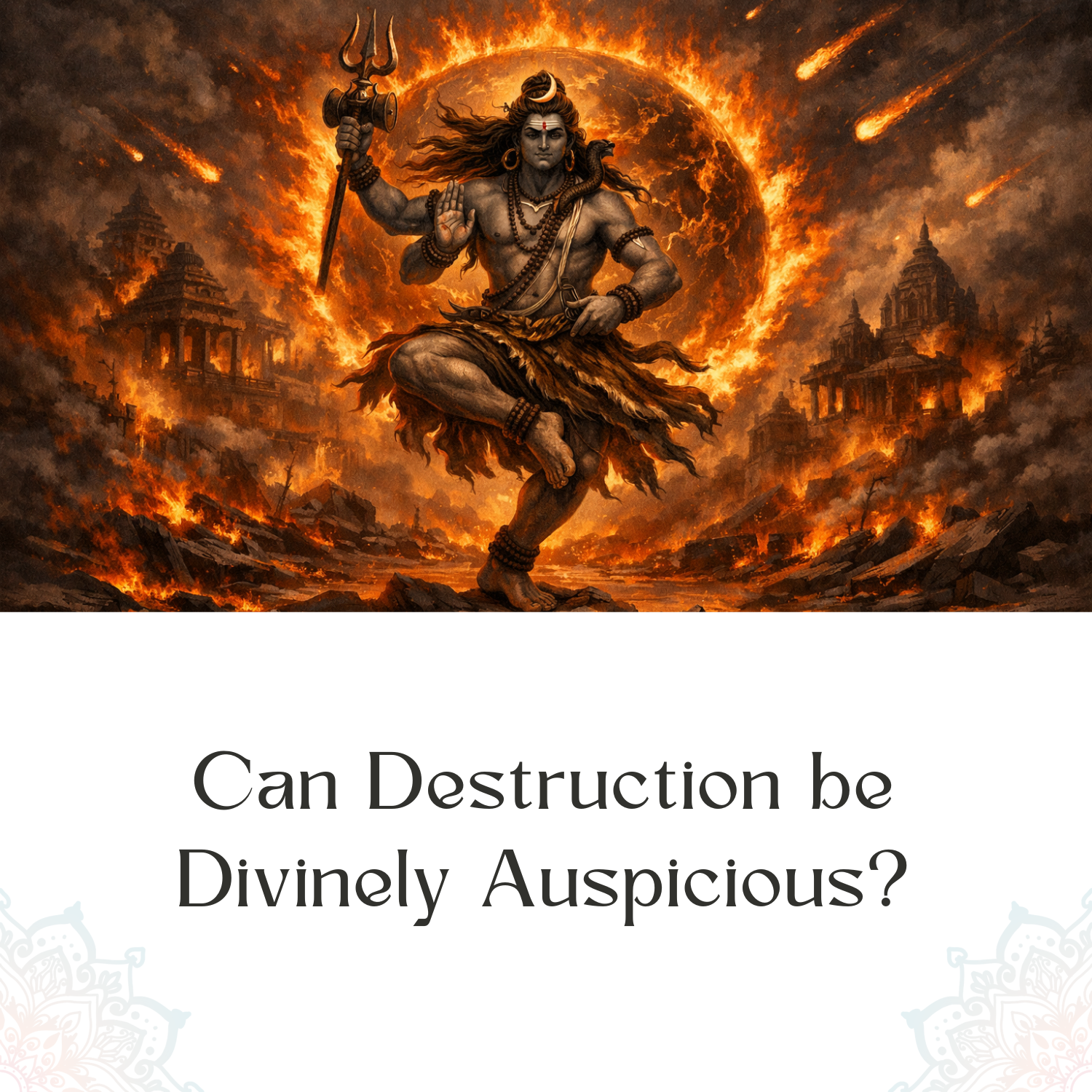
Can Destruction be Divinely Auspicious

Can Destruction be Divinely Auspicious? A Seeker’s Exporation on Shiva as Samharaka

Raghunandhan Bhaskaran

How can destruction be considered as divinely auspicious? How can Mahadeva, the Saṁhāraka, be Sada-shiva?

These questions are natural, because they are apparently contradictory, like asking how a nation state committed to non-violence, can have a standing army and invest in weapons. The answers to such seemingly contradictory ideals lie in the context.

A Knowing Wonderment

In earlier ages, people preferred to perceive the divine through ‘miracles’. But now they prefer ‘science’. Yet miracles and science are not necessarily opposed to each other.
For example the river near Kamakhya turns red during a certain season. The legend associated with it is that it represents the menstrual blood of the Devi, but scientific explanations attribute the seasonal change of color to high iron content and presence of cinnabar. Does that mean that the legend is nonsense? That depends on the attitude.

A magician does a trick and we are amazed by it. Then when we learn how the trick was performed, the amazement could turn into disappointment or turn into wonder, at the ingenuity and skill. Though ignorance is dispelled in both cases, wonder is far healthier and happier result than disappointment. Similarly, once one learns about the iron and cinnabar explanation at Kamakhya, once can be amazed by a cultural heritage which was so attuned to nature and its changes, that they mapped it their own physiology envisioning Prakriti as the Devi herself. This piece attempts to explore the Divine Destroyer from a similar perspective.

There is no life, but through life. However Sattvik we are, our food-survival is not possible, unless at least micro-organisms die. And that death, decline is entropy, a fundamental aspect of all creation. Everything declines and they have to decline for life to spring anew. Conservation of energy and mass, the transmutation of life to life, is impossible without entropy. Therefore, that entropy – destruction, which fuels creation, is auspicious. Saṁhāraka is Shiva.

That is one way to see it.

The hankering for scientific explanations is as much a result of our bias as was the hankering for supernatural miracles in past generations. The concepts of religion can also be seen through a psychological lens and sociological lens. Unlike the recent habit of humanity, which wants ‘religion’ to be a sanitized isolated package of doctrine and dogma, the dharmic heritage plays at multiple levels, all of which are interconnected. It is often a disservice to separate them as much is lost in the process.

Taking a Philosophical Approach

And then there is the philosophical way.

While the philosophies of the Dharma civilization are incredibly diverse, there are few major areas of consensus.

First is the belief in Karma and Punarjanma. Our present life is the consequence of our previous lives; our choices and actions today are influenced by our choices in the past. Second is that one of the essential purposes of life, Purushartha, is to achieve a Karma-neutral state and transcend the cycle of birth-life-death, i.e. Moksha.

I prefer not to translate Moksha as ‘escape’, ‘liberation’, ‘salvation’ etc., because that would mean that this life is a punishment. Life is an opportunity, like an opportunity to act in a movie or drama and we are method actors so completely immersed in our roles, forgetting that the role is not the real us. A suspension of disbelief, in this case is not just by the audience but also by the actors themselves. Such is the mastery of the director here- Ishwara, with his Maya-Tirodhana. When we transcend the role and are rooted in seeing ourselves as actors, then we can join the directorial vision, of enjoying both the magic trick, while being completely aware how it is done.

Yet the roles we play should lead towards that realization. What if it does not, what if the role, this life/body, further racks up Karmic burden, skewing away from neutrality? It is then like a vehicle, whose maintenance costs are far more than utility value, which is polluting and is harmful to us and society. Yet we keep it around out of attachment, unable to let go. That is when the director ends the role and destroys the vehicle which no longer serves the purpose. A life which collects Karma at a rate far more than it neutralizes, is a burden to the atma.

When we play dead to the reality of that, being so invested in the world of entropy, we are already corpses to our real selves. That is the Smashana in which he roams, wearing ashes and bones, destroying the overburdened karmic vehicle, to reset the clock with a new life.

Rarely, when an atman burns out their Karma along with their body, he is there in the cremation ground where the gross body burns. When this body/intellect is no more an effective tool for the Karmic journey, it becomes a burden. Then to carry it around is foolishness. We rather have release from it and if we do have sanchita karma, to be reset into a birth and restart our evolution. Hence, he gives us relief from the burden, by destroying what is ‘not’ us, letting us to move on. Thus, Samharaka is Shiva.

Philosophy and Empiricism

Now this philosophical concept is not empirical science. With respect to the mystery of life, there are only possible answers:

  • Random biological accident, which is not much of an explanation
  • Karma and PunarJanma, With the agency of Ishwara, arising out of his leela – Sanatana Dharma
  • With no agency mentioned, Dependent rising – Pratitiyasamuttpada of Buddhism
  • Whimsy of an Abrahamic God, whose reasons are not to be questioned.

None of the above have any empirical evidence, so it is entirely up to belief.

But if one subscribes to the Dharmic worldview, the critical importance of Saṁhāraka Shiva, to Karma and Punarjanma is undeniable.

Approaching it etymologically – word analysis, the term ‘Shiva’ in Vedas, does not explicitly point to the conception we today have, applied to Mahadeva, but is in fact applied as an attribute to Agni, Indra etc. But then Mahadeva himself was differently seen in different points of the Hindu civilizational continuum. As Rudra, as Pasupathi, as Sarva etc. His preferred weapons of Dhanush(Dhanvi), Parashu (Axe) are hardly referenced, instead Trishula has become his weapon and symbol.

Death and destruction of the corporeal body should hold no fear to the Hindu mind. Even suffering is neutralizing sanchita karma and helps the actor to dissociate from the role. It is seemingly a fearful thing that he does – Death. We don’t expect death to be avoided, though as Kalaharana/Kalasamhara, he did that as well for Markandeya. Dharma traditions are to accept death with grace and proceed with the journey of neutralizing Karma, towards Moksha.

A Perfect Equanimity of Vision

Sometimes I have wondered: Why is Vishnu always associated with Vishishtadvaita? Why is Shiva invariably associated with Advaita?
Shiva is absolutely a perfect fit for Advaita, because of his famed equanimity of vision. As Ravana sings,

स्पृषद्विचित्रतल्पयोर्भुजङ्गमौक्तिकस्रजोर्_
गरिष्ठरत्नलोष्ठयोः सुहृद्विपक्षपक्षयोः ।
तृणारविन्दचक्षुषोः प्रजामहीमहेन्द्रयोः
समप्रवृत्तिकः कदा सदाशिवं भजाम्यहम् ॥१२॥

Drushadvichitratalpayor bhujangamauktikasrajor
Garishtharatnaloshthayoh suhrudvipakshapakshayoh
Trushnaravindachakshushoh prajamahimahendrayoh
Samapravrutikahsamam pravartayanmanahkada sadashivam bhaje .. 12

When will I be able to worship Sadashiva, the eternally auspicious,
With equanimity of vision see,
both the ruled and the great emperor;
a blade of grass and a lotus;
friends and foes;
the most precious gem and a lump of dirt,
a snake and a garland or the varied forms of the world?

He is not only for joy and prosperity, he is not only for life and creation, he is there for anything terrible or frightening, for we know “he can take it”, as did Devas, Daitiyas and Danavas, when Halaahalaa came boiling up, during the Samudra Manthan. A cosmic poison which could have killed all creation. And he swallowed it with the same attitude, as though it was Amruta, that was offered to him.

To him we look to destroy us, wipe our slate clean and reset.

His destruction is like that of an orthopedic surgeon, who breaks our bones to reset them, with least pain and trauma. Shiva’s surgery is on the misaligned karmic bonds and to reset life.

Samaharaka – the destroyer, who is also Mrityunjaya – the victor over death.

What we ask of him is Anaayesena Marana – Effortless/impact-less death, as we age, body loses its vitality, mind-intellect loses memory and starts playing tricks on us. So we ask him for death while we are vital, like Uruvarukam – the cucumber which does not rot on the stem, but falls off when ripe.

ॐ त्र्यम्बकं यजामहे सुगन्धिंम् पुष्टिवर्धनम् ।उर्वारुकमिव बन्धनान् मृत्योर्मुक्षीय मामृतात् ।।

Om tryambakam yajāmahe sugandhim puṣti-vardhanam ǀ
urvārukam-iva bandhanā mṛtyormukṣīya māmṛtāat ǁ

This is what we pray to him. And he is the Ashutosha – easily pleased one obliges us. He destroys our bonds to this world and life, to let us progress.


Raghunandhan (Raghu) Bhaskaran is a Bharathi and like many today, he for long, ignored his heritage and was focused towards Artha, to the exclusion of the other Purusharthas and is yet another IT consultant. But now he is increasingly a seeker of what it means to be a Hindu, a follower of Dharma in every sphere of life – personal, social, cultural and political. Towards this, he uses writing as a sadhana, to attain clarity and shares his learning with others.

Comments are closed.